
- Germany is Europe's largest car market, with a choice and service histories that are hard to match at home. The hard part is the paperwork, not the purchase.
- You need both parts of the German registration certificate (Zulassungsbescheinigung Teil I and Teil II) and proof of purchase. Without them, the car cannot be registered in Estonia.
- A private buyer pays no VAT in Estonia on a used car. A car counts as "new" for VAT if it is under 6 months old or has under 6,000 km; then 24% Estonian VAT is due within 10 days of arrival.
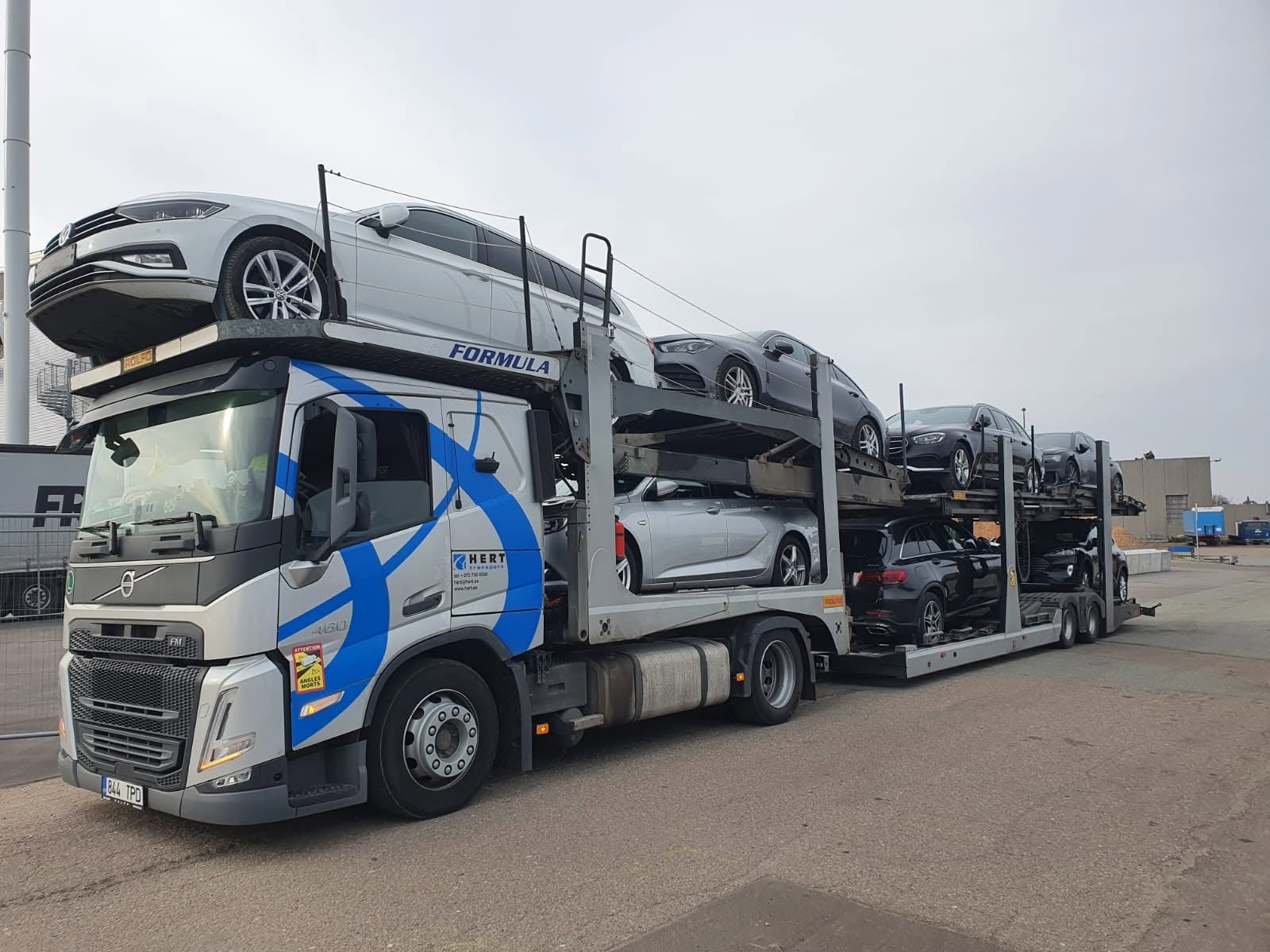
- To drive the car home, you need German export plates with insurance. On a car carrier, no plates are needed, and the trip takes 2–3 days from most of Germany to Estonia.
- Before Transpordiamet registers the car, it must pass a pre-registration inspection and the registration fee must be paid.
Every week we load cars in Germany whose new owners live a thousand kilometres away. They belong to dealerships restocking, fleet managers replacing company cars, and private buyers who found exactly the model they wanted on a German listing site. The questions we hear are always the same: which papers do I need, do I pay VAT, and how do I get the car home?
This guide walks through the whole process in five steps, from checking the car in Germany to driving away with Estonian plates. The German side applies to buyers anywhere in the EU; the registration steps are written for Estonia, with notes for Latvia, Lithuania and Finland at the end.
Why buy a car in Germany?
Germany is Europe's largest automotive market. That size works in the buyer's favour in three ways:
- Choice. Rare trims, specific colours and well-equipped premium models that may take months to find locally are often available within days.
- History. Many German cars come with a complete dealer service book (Scheckheft) and a recent roadworthiness inspection (HU, often called the TÜV).
- Supply of nearly new cars. Ex-lease and ex-company cars return to the market in large numbers after two to four years.
The trade-off is distance. You will usually buy without a test drive, and you need a plan for paperwork, tax and transport before you pay. The rest of this guide gives you that plan.
Step 1: Find and check the car
Most cars are bought through large listing sites, from three types of seller:
- Dealers issue an invoice, often handle deregistration for you and usually give a warranty on used cars. That makes them the safest option when buying remotely.
- Private sellers are often cheaper, but sell without warranty and expect you to arrange everything yourself.
- Auctions (mainly for dealers and companies) offer wide choice and good prices, but the car must be collected quickly.
Before you agree a price, check:
- The VIN is the same on the car, in the registration certificate and in the service records.
- The HU/TÜV date and any defects listed in the last inspection report.
- Service history: stamps or digital records, and when the next major service is due.
- Accident history: ask the seller to write "unfallfrei" (accident-free) into the purchase contract if they claim it. A written statement gives you a basis for a claim later.
- An independent inspection if you cannot see the car yourself. Inspection organisations and many workshops in Germany offer used-car checks for buyers.
Step 2: The German paperwork
German registration papers come in two parts, and you need both. Transpordiamet, Estonia's transport authority, requires the registration certificate of the country of origin, "both parts if the registration certificate consists of two parts", plus proof that you acquired the car legally.
| Document | What it is | Needed for |
|---|---|---|
| Zulassungsbescheinigung Teil I | Registration certificate part I (the car's technical data) | Registration in Estonia |
| Zulassungsbescheinigung Teil II | Registration certificate part II (the ownership document) | Registration in Estonia |
| Kaufvertrag or dealer invoice | Purchase contract or invoice showing seller, buyer, price and VIN | Proof of legal acquisition; VAT |
| CoC (Certificate of Conformity) | Manufacturer's EU type-approval certificate | Not required for a used car, but useful if technical data is questioned |
| Service book / records | Maintenance history | Resale value and warranty |
In practice, the car is usually deregistered in Germany (abgemeldet) before it leaves. A dealer will normally do this for you; with a private seller, agree in the contract who deregisters the car and when.
Step 3: VAT for new and used cars
For VAT, what the advert says doesn't matter. A car counts as a new means of transport if it is no more than 6 months past its first registration or has driven no more than 6,000 km. Only one of the two needs to be true. A 9-month-old car with 4,000 km is "new"; so is a 4-month-old car with 8,000 km.
| You are a private buyer and the car is… | VAT in Germany | VAT in Estonia |
|---|---|---|
| Used, bought from a private seller | None | None |
| Used, bought from a dealer | Included in the dealer's price (normal VAT or margin scheme) | None |
| New (≤ 6 months or ≤ 6,000 km) | None; the seller invoices without VAT | 24%, declared and paid by you |
For a new car, the Estonian Tax and Customs Board (EMTA) requires a special VAT return. It must be filed and the VAT paid within ten calendar days of bringing the car to Estonia, and no later than the day you register it. You then receive a printout to show Transpordiamet at registration. Estonia's standard VAT rate has been 24% since 1 July 2025.
Buying through a VAT-registered company works differently, and the details depend on your company's VAT position. Check with your accountant before you sign.
Step 4: Getting the car out of Germany
You have two options: drive it yourself or put it on a car carrier.
Driving it home means the car needs plates and insurance in Germany. The right plates for leaving the country are export plates (Ausfuhrkennzeichen), which come with their own insurance and can be issued for a few days up to a year. German short-term plates (Kurzzeitkennzeichen, valid for a few days) are meant for journeys within Germany; some countries tolerate them abroad, but you risk a fine. Berlin to Tallinn is roughly 1,050 km, plus the time needed to arrange plates and insurance locally.
Transporting it means the car travels on a carrier truck, deregistered and without plates. No German insurance is needed, no kilometres go on the clock, and you do not need to travel to Germany at all.
| Drive it yourself | Car carrier | |
|---|---|---|
| Plates and insurance | German export plates with insurance | Not needed |
| Your time | Travel to Germany + 2–3 days of driving | None: we collect the car |
| Wear on the car | 1,000–2,000 km added | None |
| If something goes wrong | Your own insurance | Carrier liability under the CMR Convention |
| Typical time to Estonia | Depends on you | 2 days from Berlin, around 3 days from southern Germany |
On a carrier, the carrier is liable for the car under the CMR Convention, and that liability is capped at 8.33 SDR per kilogram of the car's weight. For valuable cars that cap can be well below the car's value, so ask about additional insurance. Our guide to the CMR Convention explains how the cap works.
Bought a car in Germany?
We collect from dealers, auctions and private sellers across Germany and deliver to Estonia, Latvia, Lithuania and Finland.
Step 5: Registering the car in Estonia
Transpordiamet registers vehicles in Estonia. A used car from another country cannot be registered online; it must be presented at a service bureau. Follow these steps in order:
- New car only: pay the VAT. File the special VAT return with EMTA and pay 24% VAT within 10 days of the car's arrival (see Step 3).
- Pre-registration inspection. Book a time at a Transpordiamet service bureau that carries out the inspection. Bring both parts of the German registration certificate, your ID and proof of purchase. At the inspection, the car is identified and checked against its type approval and documents. The inspection report is valid for 12 months.
- Pay the registration fee. Since 2025, Estonia charges a one-off registration fee (registreerimistasu) before a car can be registered. It depends on the car's CO₂ emissions, weight and age, and averages less than ten percent of the car's value. Transpordiamet's online car-tax calculator shows the exact amount.
- Get motor insurance. Compulsory motor insurance (liikluskindlustus) must be in place before the car is used on the road.
- Register the car. At the service bureau you submit the application and documents, pay the state fee, and receive the Estonian registration certificate and plates.
Timing matters: once you start using the car in Estonia, it must be registered within five working days. After registration, the car is also subject to Estonia's annual motor vehicle tax, which is based on the same CO₂ and weight data.
Importing to Latvia, Lithuania or Finland
The German side of the process (Steps 1–4) is the same wherever in the EU the car is going. Registration and tax rules, however, differ by country:
- Latvia: registration is handled by the Road Traffic Safety Directorate (CSDD).
- Lithuania: registration is handled by Regitra.
- Finland: a car tax (autovero) is paid to the Finnish Tax Administration before the car is registered with Traficom.
The EU VAT rule from Step 3 (new = under 6 months or under 6,000 km) applies in all four countries, but the VAT rate depends on the country where you register the car.
Frequently asked questions
- Do I pay VAT twice when importing a car from Germany? No. With a used car, VAT is only included in the price if you buy from a dealer, and it is paid in Germany. A new car (under 6 months or under 6,000 km) is invoiced without German VAT and taxed only in the country where you register it.
- Can I drive a car with German short-term plates to Estonia? Short-term plates are intended for journeys within Germany. For leaving the country, use export plates (Ausfuhrkennzeichen) with their own insurance, or transport the car on a carrier, which needs no plates at all.
- How long does car transport from Germany to Estonia take? Typically 2 days from Berlin and around 3 days from southern Germany after collection. A single car may wait a few days for the next scheduled departure.
- Do I need a Certificate of Conformity (CoC) for a used car? Transpordiamet requires the foreign registration certificate (both parts) and proof of purchase for a used car. A CoC is not on the list, but it can help if the technical data needs to be confirmed.
- How much is the Estonian registration fee? It depends on the car's CO₂ emissions, weight and age, and averages less than ten percent of the car's value. Transpordiamet's car-tax calculator gives the exact figure for a specific car.
- Does the car have to be deregistered in Germany? In practice, yes. Dealers usually handle it; with a private seller, agree in the contract who deregisters the car and when, and make sure you receive both parts of the registration certificate.
- Can the car be collected from a private seller? Yes. We collect from private addresses, dealers and auction sites alike. Agree the collection time with the seller and make sure the documents and keys are handed over together with the car.
Importing a car from Germany is not complicated, but it rewards preparation. Check the car and its papers before you pay, find out whether the car counts as new or used for VAT, choose how it travels, and book the Estonian inspection early. Follow these steps in order and the car goes from a German listing to Estonian plates without surprises.