
- Open carrier is the most cost-efficient method for fleet vehicles, dealer stock, and import batches. A typical transporter carries 6–8 vehicles per run.
- A signed condition report at collection is your only protection against disputed damage claims. Never allow collection without one.
- The CMR waybill is the legal contract of carriage; both parties sign at collection and again at delivery.
- EU drivers' hours regulations (45-hour weekly rest) can add a day to transit. Build this into planning windows on longer routes.
- Nothing should be left inside the vehicle: carrier insurance does not cover personal property and undeclared items create customs complications on international routes.
Most of what goes wrong with vehicle transport doesn't happen on the road. It happens before the carrier leaves: missing paperwork, unclear collection windows, a condition report nobody signed. This guide walks through what actually happens from the moment a booking is confirmed to the vehicle arriving at your facility, so you know what to expect and what to verify at each step.
Open carrier transport is the standard method for moving production vehicles, dealer stock, and fleet transfers across Europe. A typical car transporter carries six to eight vehicles per run, distributing the cost across the load and making it significantly more economical per unit than enclosed transport. The trade-off is exposure to road conditions and weather, which is acceptable for standard vehicles, but not the right choice for high-value classics or restored vehicles where cosmetic condition during transit is a primary concern. For the vast majority of commercial vehicle movements, open carrier is the practical default.
Booking and Pre-Transport Documentation
A clean booking starts with complete information. Your transport provider needs: make, model, year, and VIN for each vehicle; exact dimensions if any unit is non-standard (lowered, widened, or fitted with oversized aftermarket components); collection address with a named contact and direct phone number; delivery address; vehicle condition status (running or non-running); and your preferred pickup window. Missing any of these at the booking stage creates delays downstream.
The CMR waybill is the core legal document for international road freight. It functions as the contract of carriage between you and the transport operator, defining the cargo, the parties, the route, and the liability terms. Both shipper and carrier sign at collection; both consignee and carrier sign at delivery. Keep your copy. If a dispute arises over damage or missing items, the CMR is the document that determines who bears what liability.
The condition report is completed at the time of vehicle collection, with photographs. This protects both parties: it establishes the vehicle's pre-transport state so any damage that occurs in transit can be attributed correctly. If you allow collection without a signed condition report, your ability to make a damage claim later is severely compromised. Typical booking-to-pickup lead time on standard Baltic-to-Western-Europe corridors is two to five working days.
The Collection Process
On Hert's core Baltic routes, covering Estonia, Latvia, and Lithuania to Germany, Benelux, and Scandinavia, the driver is one of Hert's own, working a corridor they know well. For destinations further afield, our European partner network provides access to vetted transport partners operating under the same documentation standards.
On the day of collection, the driver calls the contact at the collection address typically one to two hours before arrival. At the collection point, the driver conducts a walkthrough inspection: visible damage is noted, photos are taken, and the condition is documented on the CMR. Any pre-existing damage (chips, scratches, dents) should be noted regardless of how minor. The driver takes a signed copy; you keep a copy.
For non-running vehicles, a winch-loading capable transporter must be pre-assigned. This affects scheduling and carries an additional cost, so notify your transport provider at booking, not on the day of collection.
Loading and Securing on the Carrier
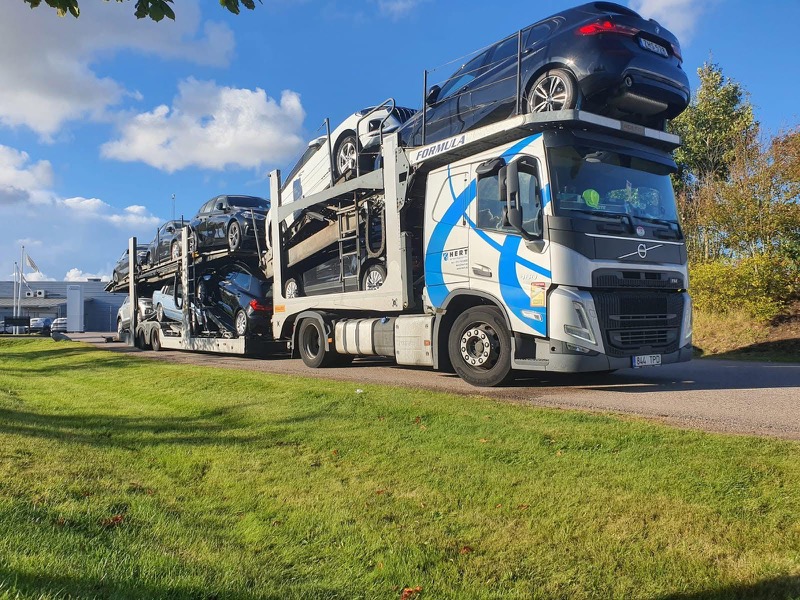
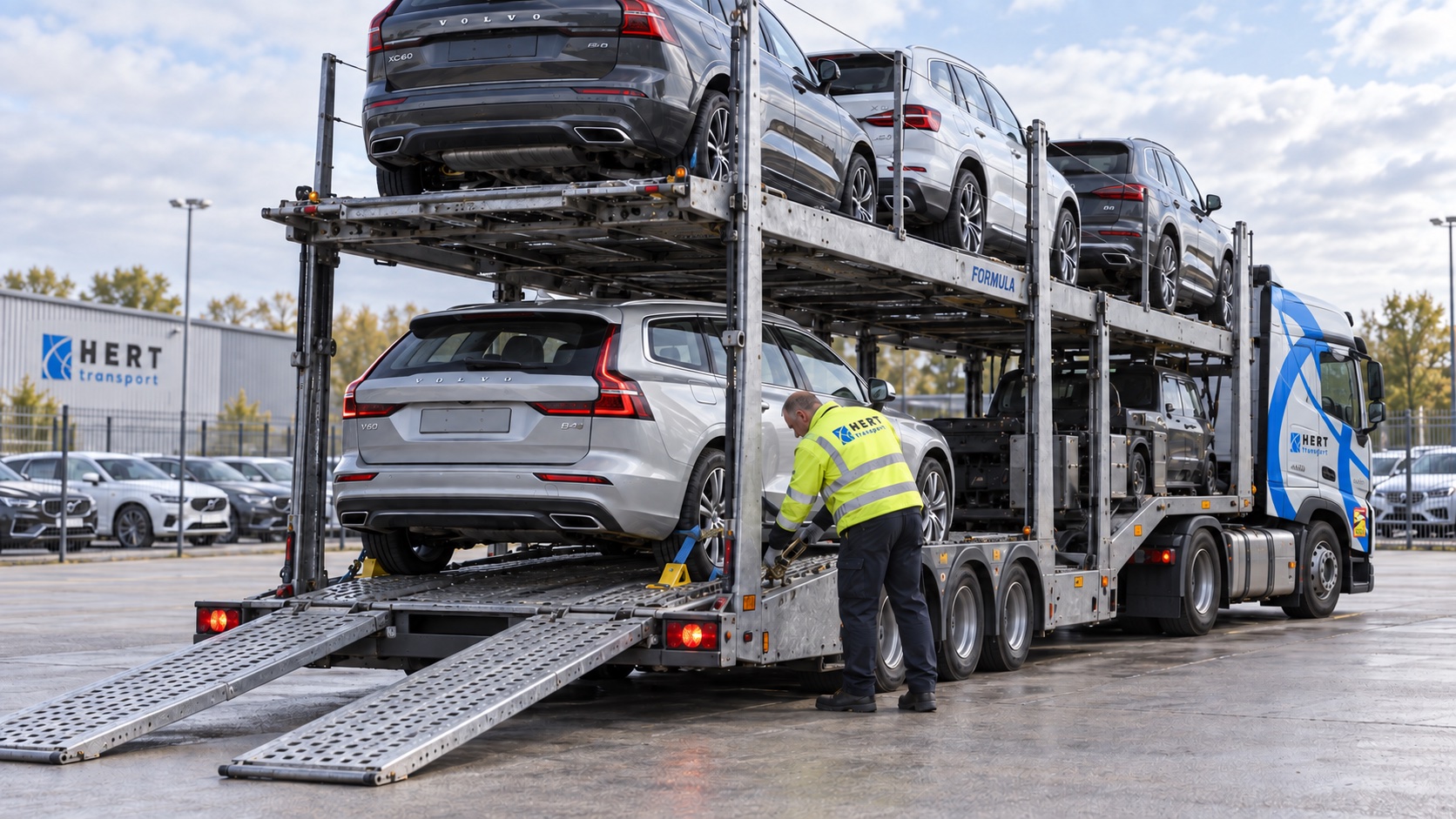
Loading sequence on a multi-vehicle carrier is not arbitrary. The driver plans the load based on weight distribution across the vehicle's axles, deck configuration, and the delivery sequence on the route. Vehicles to be delivered last are typically loaded first. Ground clearance matters: low vehicles go on the upper deck where the ramp angle is shallower.
Once positioned, each vehicle is secured with wheel chocks and tie-down straps through the wheel arches. Straps are never hooked to suspension components, tow points, or bodywork. Prepare the vehicle with folded mirrors, retracted antennas, and no loose items attached to the exterior.
Nothing should be left inside the vehicle. Carrier insurance does not cover personal property. On cross-border shipments, undeclared items inside the vehicle can create customs complications. Strip the vehicle of all personal items before handover.
Moving vehicles across Europe regularly?
Hert operates scheduled runs between the Baltics and Germany, Benelux, and beyond. Fixed schedules reduce per-vehicle cost on recurring loads.
In Transit: What You Can Track
GPS tracking shows the carrier's current location, estimated arrival time, and driver contact details. For operational planning, such as knowing when to have someone available at the delivery point, this is the primary tool. Updates are live; there is no need to call the operations team for a routine location check.
One source of confusion is transit time variability around Thursday and Friday, particularly on long-haul routes. EU drivers' hours regulations require a 45-hour weekly rest period after six days of driving. If a shipment is loaded mid-week on a multi-day route, the driver's rest period may fall within your transit window. This adds a day to delivery and is not a delay; it is scheduled regulatory compliance. If your timeline is tight, ask your transport contact at booking whether the route timing intersects with a rest period.
The CMR Convention sets the carrier's maximum liability at 8.33 SDR per kilogram of gross cargo weight, not the vehicle's market value. For high-value vehicles, ask your transport provider about supplemental cargo insurance before booking.
Delivery and Final Inspection
The driver calls the delivery contact approximately 24 hours before arrival to confirm the window. Someone with authority to sign the CMR must be present at the delivery point.
Walk around each vehicle with the driver before signing anything. Check against the collection condition report. If any damage is visible that was not noted at collection, mark it clearly on the CMR before signing. Signing the CMR without noting damage is treated as acceptance of the vehicle in the documented condition.
For damage that is not immediately visible, the CMR Convention gives you seven days to file a written protest from the date of delivery. After that window closes, claims become substantially harder to pursue. Typical transit times: Baltics to Germany, two to three days; to Benelux, three to four days; to France, four days.
Common Questions
- Can I leave items in the vehicle? No. Carrier insurance does not cover personal property, and undeclared goods create customs complications on international routes.
- Do I need to be at the collection point? Not required if an authorised person is present, but that person must have signing authority for the CMR and the condition report.
- What if my vehicle won't start? Notify at booking. Winch loading adds cost and affects which transporter is assigned. Last-minute disclosure causes scheduling delays.
- What's the difference between door-to-door and terminal-to-terminal? Door-to-door means collection and delivery at your specified addresses. Terminal pricing requires you to deliver to a depot for loading and collect from a depot at the destination. Lower cost, but more of your logistics involved.
If you're coordinating regular vehicle movements such as dealer stock rotation, fleet transfer, or import distribution, a recurring schedule reduces per-vehicle cost and gives your operations team a reliable transport window. Contact Hert to discuss route options.